
What to know about
Celigo Integrations
What Are Celigo Integrations
Celigo integrations use the Celigo iPaaS platform to connect business systems and automate data flows between them. Celigo is commonly used to integrate ERP, ecommerce, CRM, finance, and logistics platforms, creating a more connected and efficient technology stack.
At GAP, Celigo integrations are a core part of how we connect systems to NetSuite, but our experience goes beyond that. We also design Celigo integrations between non NetSuite platforms when businesses need reliable data movement across multiple systems. The goal is always the same, accurate data, predictable workflows, and systems that work together cleanly.
Why Work With a Team of Celigo and NetSuite Experts
Celigo is a powerful integration platform, but successful integrations depend on more than the tool itself. Working with a team that understands system architecture, data models, and business processes ensures Celigo is configured correctly and used to its full potential.
GAP brings deep NetSuite expertise to every Celigo integration, which is critical when NetSuite is part of the ecosystem. That same architectural discipline allows us to integrate other systems with each other using Celigo, even when NetSuite is not involved. Experience across platforms reduces risk and improves long term stability.
Why Companies Choose GAP
Strong Integration Architecture
We design Celigo integrations with clear data ownership and predictable behavior. This ensures systems stay in sync and data can be trusted.
NetSuite Expertise Where It Matters
When NetSuite is part of the integration landscape, deep platform knowledge is critical. Our NetSuite experience ensures data lands correctly and supports financial and operational workflows.
Support for Multi System Environments
We regularly use Celigo to integrate systems beyond NetSuite. This includes ecommerce, CRM, finance, and operational platforms that need to exchange data reliably.
Clear Communication and Documentation
We document integration logic and data flows so teams understand how Celigo is being used. Clear documentation reduces dependency on outside support.
GAP’s Approach to Celigo Integrations
Integration Discovery & Assessment
We start by reviewing your systems, existing integrations, and business requirements. This includes understanding transaction volume, data dependencies, and pain points. A thorough assessment ensures Celigo is applied in the right way. This step helps avoid unnecessary complexity later.
Integration Architecture Design
We design Celigo flows with a clear understanding of how systems should interact. This includes defining source of truth, mapping data correctly, and planning for exceptions. Architecture decisions are made with scalability and maintainability in mind. Predictable behavior is a priority.
Celigo Configuration & Build
We configure Celigo flows, mappings, and automation using best practices. Monitoring and error handling are built in from the start. Clean configuration reduces noise and simplifies troubleshooting. The result is integrations that feel controlled rather than fragile.
Testing & Validation
Every Celigo integration is tested across real world scenarios. We validate data accuracy, timing, and exception handling. Thorough testing reduces post launch issues and builds confidence in the system.
Deployment & Transition
We support a controlled go live process with clear communication. Documentation ensures your team understands how integrations work and how to respond to issues. A smooth transition helps integrations succeed long term.
Ongoing Support & Optimization
As systems change, integrations need to adapt. We support ongoing improvements, enhancements, and optimization to keep Celigo integrations aligned with business needs. Ongoing care ensures integrations continue delivering value.
GAP combines deep NetSuite technical expertise with a strong understanding of finance operations, allowing them to consistently guide us toward practical, optimal solutions.
Matthieu Bertho
Director of Finance at Poolside AI
GAP enabled technology to help our company grow by integrating our custom Shopify B2B Dealer Portal with NetSuite. Thank you, GAP!
Brad Prososki
Owner at Iron Bear Trailer
Common Systems Integrated Using Celigo
Add paragraph text. Click “Edit Text” to update the font, size and more. To change and reuse text themes, go to Site Styles.
1
ERP & Financial Systems
NetSuite, Acumatica, Epicor, SAP, Workday
ERP & Financial Systems
NetSuite, Acumatica, Epicor, SAP, Workday
1
Add paragraph text. Click “Edit Text” to update the font, size and more. To change and reuse text themes, go to Site Styles.
2
Ecommerce Platforms
Shopify, BigCommerce, Magento, WooCommerce, eBay
Ecommerce Platforms
Shopify, BigCommerce, Magento, WooCommerce, eBay
2
Add paragraph text. Click “Edit Text” to update the font, size and more. To change and reuse text themes, go to Site Styles.
3
Marketplaces
Amazon Seller Central, Walmart Marketplace, TikTok Shop, Wayfair
Marketplaces
Amazon Seller Central, Walmart Marketplace, TikTok Shop, Wayfair
3
Add paragraph text. Click “Edit Text” to update the font, size and more. To change and reuse text themes, go to Site Styles.
4
CRM Systems
Salesforce, HubSpot, Insightly, Zendesk, Zoho
CRM Systems
Salesforce, HubSpot, Insightly, Zendesk, Zoho
4
Add paragraph text. Click “Edit Text” to update the font, size and more. To change and reuse text themes, go to Site Styles.
5
Logistics and Fulfillment
ShipStation, ShipHero, 3PL Central, Pacejet
Logistics and Fulfillment
ShipStation, ShipHero, 3PL Central, Pacejet
5
Add paragraph text. Click “Edit Text” to update the font, size and more. To change and reuse text themes, go to Site Styles.
6
Payment Processors
Stripe, PayPal, Square, Klarna, Affirm
Payment Processors
Stripe, PayPal, Square, Klarna, Affirm
6
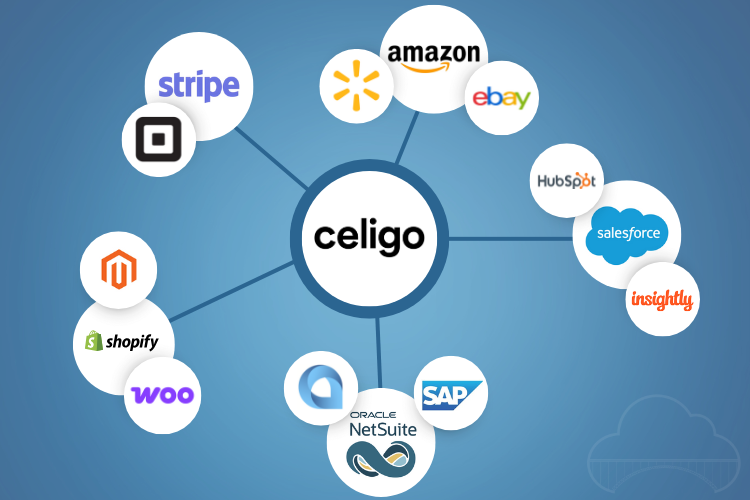
Celigo supports thousands of pre built connectors across ERP, ecommerce, CRM, finance, logistics, and operational platforms. This allows businesses to integrate a wide variety of systems without starting from scratch each time. The examples listed above represent some of the most common systems we work with, but they are by no means exhaustive. If a platform exposes data through APIs, flat files, or standard integration methods, Celigo is often a strong option for connecting it reliably.
Trusted By
Celigo Integrations FAQs
What are Celigo integrations?
Celigo integrations use the Celigo platform to connect systems and automate data flows. They help reduce manual work and improve data consistency.
Can Celigo integrate systems without NetSuite?
Yes, Celigo can be used to integrate systems even when NetSuite is not involved. GAP has experience designing integrations across a wide range of platforms.
Why is integration architecture important with Celigo?
Poor architecture can lead to fragile integrations and recurring issues. Thoughtful design improves stability and scalability.
Can you fix existing Celigo integrations?
Yes, we frequently repair and optimize Celigo integrations built by other partners. This includes improving mappings and error handling.
How long does a Celigo integration take?
Timelines vary based on scope and complexity. Many integrations are completed in several weeks.
Does Celigo provide monitoring and alerts?
Celigo includes monitoring tools, but proper configuration is essential to make them effective.
Are Celigo integrations scalable?
Yes, when designed correctly. Architecture and configuration play a key role in handling increased volume.
Do Celigo integrations require ongoing support?
Like any integration platform, ongoing support helps ensure integrations remain reliable as systems change.
Stay Up To Date On
All Things NetSuite
What Is Celigo? A Simple Guide to How It Really Works
Modern businesses rely on countless cloud apps, but disconnected systems lead to manual work, data errors, and slow processes. Celigo solves this by connecting applications and automating the workflows between them. With prebuilt integrations and a powerful visual builder, Celigo brings real-time visibility, streamlined operations, and scalable automation to any growing business.

The Business Case for a Shopify Plus NetSuite Integration
You deal with messy orders every day. Phone calls. Emails. Even that old fax machine. Then your team jumps in to retype everything into NetSuite, chase stock updates, and answer nonstop pricing questions. It slows everyone down. A Shopify Plus NetSuite integration clears that chaos. You sync data in real time, cut manual work, reduce errors, and give Customers the info they need instantly. In this post, you will see how the integration works, the fast ROI B2B teams are seeing, and why this setup

Manage Bank Reconciliations with NetSuite
For businesses with high transaction volumes, multiple bank accounts, or various currencies, bank reconciliation can be time-consuming. NetSuite’s Bank Data Matching and Reconciliation can automate the manual comparison of bank data with accounting records, allowing users to automatically import bank data, saving time and improving accuracy. Bank reconciliation is crucial for aligning cash balances from bank statements with accounting records. It enhances cash flow management, improves...